I was at a stranger's funeral in a tiny chapel when a voice called my name — what it told me froze me to my core!
My heart pounded as I turned to see who was calling me on such an unexpected day. The voice seemed familiar, but in such a strange place, I couldn't comprehend it. What he revealed left me utterly speechless.
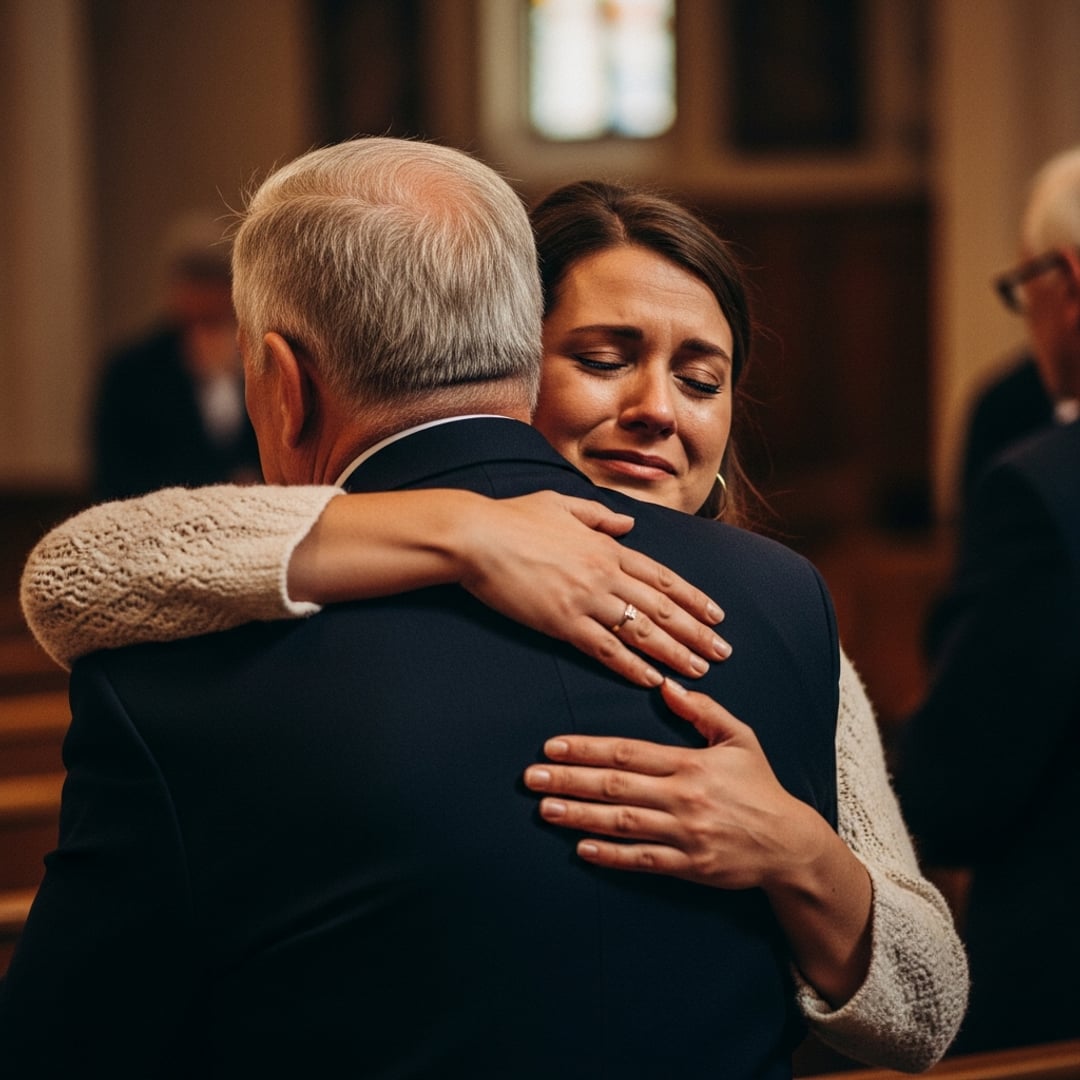
The scent of cloves and incense hung heavy in the air of the small chapel. The ancient stone walls seemed to absorb every muffled sigh. I was there, at the funeral of someone I’d never met, simply to support my childhood friend, Marta. The priest was midway through his homily when a husky, hesitant voice whispered my name. “Isabela?”
My heart leaped. That voice… it couldn’t be. I turned slowly, my eyes scanning among the grieving faces. And then I saw him. He was at the back, near the door, his face etched with time, his eyes still carrying the same intensity I remembered. My father. After fifteen years. “DAD?!” The word escaped my lips before I could stop it. A few curious glances turned our way. His voice, louder now, cut through the respectful silence. “YES! IT’S ME! I NEED TO TALK TO YOU! IT’S IMPORTANT!”
I walked towards him, my legs feeling like jelly. “What are you doing here?” I asked, my voice thick with emotion. He looked at the coffin, then at me, his eyes filled with a grief I had never seen before. “This… this is my brother, Ricardo,” he said, his voice almost inaudible. “Your uncle.”
I was seven when my father left. I remember that day as if it were yesterday. Mom was in the kitchen, the smell of corn cake filling the house. Dad was sitting at the table, his work brief open, but he wasn’t reading. He seemed distant. “I have to go, Laura,” he told my mother, his voice low. “I can’t… I can’t do this anymore.” Mom dropped her coffee cup. “Do what, Carlos? Abandon us?” I was playing with my teddy bear, a faded blue rabbit, and their words seemed like dark clouds over my head. I remember him bending down, kissing my forehead, and saying, “Your mother will take good care of you, my love. Be a good girl.” And then he left. Without looking back. Without explanations. Just an emptiness that was never filled.
My mother, a strong and hardworking woman, never spoke ill of him, but the silence about the subject was heavy. She worked tirelessly to raise me, working two house jobs to ensure I had everything. I saw her cry in secret some nights, but she always composed herself the next day with a smile for me. I grew up with a mix of anger and sadness, questioning why my father had never tried to contact me. No birthday cards, no phone calls. Nothing. To me, he was a painful, distant memory.
Now, fifteen years later, he was there, in front of me, at a funeral. My inner world was in chaos. “Uncle Ricardo? I didn’t know I had an Uncle Ricardo,” I said, my emotions churning. He pulled me into a more secluded corner of the chapel. “It’s a long story, Isabela. I should have told you. I should have told you everything.” He looked exhausted, his skin pale and eyes red.
“What do you have to tell me that you couldn’t say in fifteen years?” the bitterness in my voice was palpable. He took my hand, his hands wrinkled and rough. “I left because Ricardo was sick. Very sick. He needed bone marrow transplants, and I was the only match. He had insurance that covered the treatment, but not the accommodation and family expenses in São Paulo, where he was being treated. I needed to go, work, and the money barely covered his expenses and what I sent to you all. I couldn’t take you, Isabela. Your place was with your mother. I didn’t want you to see his illness, the pain. I thought it was the right thing to do.” He paused, his eyes welling up. “I tried to call a few times, but your mother… she was heartbroken, and I understood. She told me not to bother you. That she would take care of everything. And I, being the coward I was, respected that. I should have fought harder.” He pulled out an old, yellowed envelope from his pocket. “Ricardo always kept this. It was for you. He wanted me to give it to you if I ever saw you again.”
I opened the envelope with trembling hands. Inside, there was an old photo of a smiling woman holding a baby. On the back, my father’s handwriting: “My sister Ana, your aunt, and me with you, Isabela, in your first month. Ricardo always loved you very much. He was a second father to us when Mom and Dad passed away early.” There was also a savings account. A considerable sum. “Ricardo always saved a little of what I sent him, saying it was yours. That it was your right, and he didn’t need that much,” my father explained, his voice choked.
Tears began to stream down my face. They weren’t just tears of sadness, but of shock and an overwhelming mix of relief and regret. My father hadn’t abandoned me out of selfishness. He had made a silent sacrifice for his brother and for me, even if the distance had been devastating. I had judged him all this time. All my anger began to unravel, replaced by a painful understanding.
I hugged my father, an awkward embrace at first, then tighter, feeling all the years of absence, all the unspoken pains, all the longing I didn’t even know I had. “Dad… forgive me. I didn’t know.” He just held me tighter. “I love you, daughter. Always have. Never doubt that.” That day, at a funeral, I not only reconnected with my father but also unearthed a part of my family I didn’t even know existed. I learned that things are not always what they seem, and that love, sometimes, manifests in the most silent and painful sacrifices. And that forgiveness, both for oneself and for others, is the only bridge to healing.